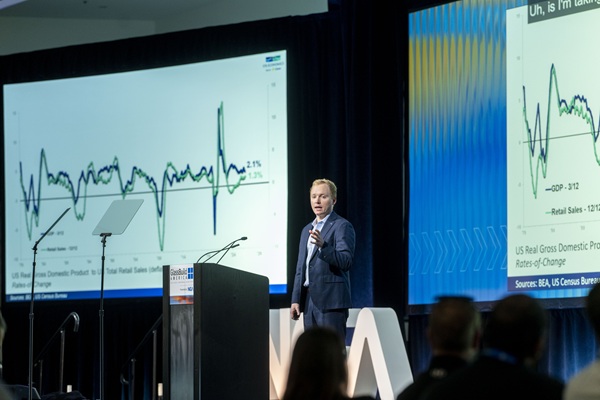
“Oil's up, interest rates are up, and uncertainty is up,” said Connor Lokar, senior forecaster for ITR Economics, summarizing his firm’s outlook for the US economy in his keynote address at GlassBuild America 2026 in Las Vegas. “It's some good, some bad, some ugly.”
Lokar’s outlook for the U.S. GDP is mixed: the economy is growing and he expects the growth to continue, but it will slow in 2027, beginning to stall as we move into next year. “It's not a recession, but we do have some headwinds coming [in the broader economy],” said Lokar.
While Lokar expects the economy to slow, he urged businesses to remain active. “It doesn't mean you can't grow your business. It means the economy won't do it for you,” he said. Lokar encourages companies to have a plan, whether it be to introduce new products, explore new markets, or take advantage of new opportunities.
Global perspective
From a global perspective, Lokar said both the U.S. and world economies have continued to move ahead despite challenges, although he says both the U.S. and world economies are decelerating.
Lokar predicts that growth will continue through 2026 into 2027. But by this time next year, he predicts, there will be a “softening” in the economy, but not a recession. He predicts that in 2028 the economy will pick up again.
Oil prices a concern
Lokar highlighted oil prices as a concern. If prices per barrel remain in the high $80s, $90s or above, consumers will struggle. “The consumer can only take so much,” he said.
The good news, according to Lokar, is that the U.S. has a lot of oil, and doesn’t need Middle Eastern oil to the same extent it did in 2008 during the last oil spike. “That's a tremendous situation to be in in a geopolitical situation such as this,” he said. He predicts that the U.S. will have the oil it needs, but the same can't be said for Europe.
The U.S. Economy
For the most part, services are stable and consistent, according to Lokar, with services and industry on a growth trajectory, and consumers are spending at a healthy rate despite some ominous headlines. Adjusting for inflation, the 1.3% growth rate in the economy jumps to 4.5%.
However, the K-shaped economy affects the poorest Americans the most: For the poorest 20%, food, lodging, and healthcare consume 67% of income, leaving only one-third of their income for everything else.
Conversely, for the wealthiest 20%, food, lodging, and healthcare take up only 47% of income, leaving more than half of income for everything else.
The post-Covid experience has been "catastrophic" for lower income Americans, while it's been less impactful for the wealthiest Americans, according to Lokar.
The construction market
“The residential market is not doing well and won't be doing any better anytime soon,” said Lokar, who doesn’t forecast the sector improving until 2028. “The bleeding will start slowing down for housing next year,” he predicts. “It won't stop, but it'll start to slow.”
“It's not that you can't grow next year, it's just that the market won't do it for you,” Lokar said.
Private nonresidential construction is flat, and Lokar predicts more of the same. Education, warehouse, office, manufacturing, and multitenant retail sectors are down while water and sewer, data centers, and hospitals are up. “If I'm waiting for a big market change catalyst to fix my business, it's not coming. Time to put your hands on the steering wheel. It’s not going to come walking in the door. It won't get dramatically better,” he said.
Depression forecast
ITR is forecasting an economic depression in the first half of the 2030s, said Lokar. He predicts the economy will decline from 2030 through 2035. “Any one year will not be as bad as the worst years of 2008-09, but there will be a lot of underwhelming years stacked together,” Lokar said.